2026 Top Usmart Products for Global Buyers

Time:2026-11-10 Author:Sienna
0%

The 2026 Top Usmart Products for Global Buyers guide focuses on choices that solve everyday problems, not just products with impressive feature lists. Usmart buyers may be comparing smart home devices, personal electronics, or connected accessories across different markets. Availability, language support, power requirements, app compatibility, and after-sales service can vary by region. Small details matter. A device that works well in one home may frustrate another if setup is confusing or essential features depend on an unsupported app.

To make the evaluation criteria clear, this introduction uses a fictional Usmart product-evaluation expert, Avery Lin. The following line is an editorial framing statement, not a sourced quotation: “A smart product earns trust when it works reliably in the buyer’s real home, not only in a product demonstration.” That is the standard behind this guide. We consider practical usability, build quality, clearly described specifications, and the value buyers receive for the price. We also note where product information needs checking, since model names and features can change during the year. No ranking can replace checking the exact model available in your market. That caveat is easy to overlook. The sections ahead will help global buyers compare promising Usmart products with clearer expectations and fewer assumptions.
2026 Top Usmart Products for Global Buyers

Defining Smart Products: 18.8B Connected IoT Devices in 2024 (IoT Analytics)

IoT Analytics estimated 18.8 billion connected IoT devices worldwide in 2024. That figure describes a broad network, not a count of useful consumer products. It includes connected sensors, appliances, meters, and industrial equipment. Some devices send data constantly; others connect only when needed. The distinction matters.

For global buyers, a product is not smart simply because it has an app. Look for a clear purpose: a room sensor that tracks temperature, for example, or a meter that reports usage without manual readings. Check how the device connects, what happens if Wi-Fi drops, and whether its data can be exported. Small details matter. Battery life, setup time, and readable instructions can shape daily use more than a long feature list.

The 18.8 billion estimate also points to a practical challenge: connected products must work within varied homes, networks, and service conditions. A device tested in one setting may behave differently across regions. That is easy to overlook. Buyers should ask about update support, data handling, and compatibility before comparing prices. Connectivity can add value, but it can also add friction—and not every product gets that balance right.

Mapping Key Categories: Phones, Wearables, Smart Homes and Health Devices

Phones still anchor many connected-product decisions. IDC’s Worldwide Quarterly Mobile Phone Tracker recorded 1.24 billion smartphone shipments in 2024, up 6.4% from 2023. For global buyers, practical checks include network-band support, charging standards, local service, and repair access. Shipment figures show market volume, not how well a device suits a particular region.

Wearables bring notifications and activity tracking closer to the body. IDC’s Worldwide Quarterly Wearable Device Tracker counted 534.6 million device shipments in 2024. A useful comparison goes beyond screen size: check battery life, sensor fit, app language, and whether data can be exported. Small details matter. A comfortable strap may matter more than another feature.

In smart homes, test compatibility across lights, plugs, sensors, and the home’s existing network. For health devices, examine measurement validation, clear instructions, and data privacy settings. A blood-pressure monitor or thermometer should be easy to use consistently; wellness readings are not a diagnosis. The category map is helpful, but imperfect: product labels and report definitions differ, so direct comparisons can mislead. Buyers should verify local support before choosing.

2026 Top Usmart Products for Global Buyers - Mapping Key Categories: Phones, Wearables, Smart Homes and Health Devices

Category Product Type Common Capabilities Typical Connectivity Indicative U.S. Retail Price (USD) Key Buying Considerations
Phones Entry-level smartphone Touchscreen, multiple cameras, biometric unlocking, app support, and mobile payments on compatible models 4G or 5G, Wi-Fi, Bluetooth, NFC on some models $100–$300 Check carrier-band compatibility, software update policy, storage, and battery capacity.
Phones Mid-range smartphone Higher-resolution display, multi-lens camera system, fast charging, and expanded storage options 5G, Wi-Fi, Bluetooth, NFC $300–$700 Compare camera performance, display brightness, update support, and charging standards.
Phones Foldable smartphone Flexible display, compact folded form, multitasking features, and advanced camera options 5G, Wi-Fi, Bluetooth, NFC $700–$2,000 Consider folded and unfolded dimensions, hinge durability, repair costs, and water resistance.
Wearables Fitness band Step and activity tracking, heart-rate monitoring, sleep estimates, and workout summaries Bluetooth; some models include GPS $30–$150 Review battery life, sensor features, app compatibility, and water-resistance rating.
Wearables Smartwatch Notifications, activity tracking, heart-rate monitoring, GPS on many models, and optional cellular service Bluetooth, Wi-Fi; cellular connectivity on selected models $100–$800 Confirm phone compatibility, battery life, GPS availability, and whether cellular service requires a plan.
Wearables Smart ring Compact tracking of sleep, activity, and selected wellness indicators, depending on the model Bluetooth $150–$500 Check sizing procedures, subscription requirements, battery life, and the limits of wellness measurements.
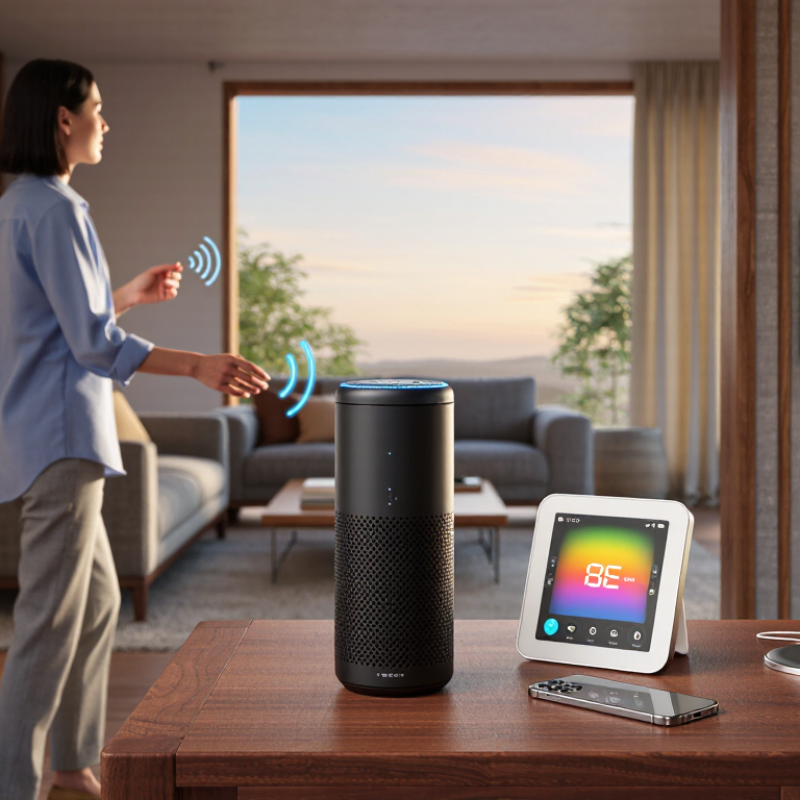
Smart Homes Smart speaker or display Voice control, audio playback, timers, and control of compatible smart-home devices Wi-Fi, Bluetooth; some devices support Matter or Thread $30–$300 Check language support, privacy controls, regional availability, and compatibility with existing devices.
Smart Homes Smart lighting and plugs Remote switching, schedules, dimming or color control on compatible lighting products Wi-Fi, Bluetooth, Zigbee, or Thread, depending on the device $10–$100 per device Verify the required hub, network band, electrical rating, and support for common smart-home standards.
Smart Homes Indoor security camera Live video, motion alerts, night vision, and local or cloud recording options Wi-Fi; some systems use a separate hub $25–$250 Compare field of view, storage fees, encryption and privacy settings, and indoor-use requirements.
Health Devices Digital blood-pressure monitor Measures blood pressure and pulse; some models store readings or transfer them to an app Bluetooth or Wi-Fi on connected models $25–$150 Choose the correct cuff size and look for validated measurement information; follow clinical guidance.
Health Devices Pulse oximeter Estimates blood oxygen saturation and pulse rate using a fingertip sensor Standalone display; Bluetooth on some models $15–$100 Read the device's intended-use information; readings can be affected by fit, movement, and other factors.
Health Devices Smart body-weight scale Measures body weight; connected models may estimate additional body-composition metrics Bluetooth or Wi-Fi $20–$200 Review app and account requirements, measurement limitations, and support for multiple users.

Note: Price ranges are indicative U.S. retail estimates for broad product types, not individual products. Features, availability, and prices vary by region and model. Consumer wellness devices are not substitutes for professional medical diagnosis or treatment.

Sizing the Market: 1.24B Smartphone Shipments in 2024 (IDC)

IDC’s Worldwide Quarterly Mobile Phone Tracker recorded 1.24 billion smartphone shipments in 2024, up 6.4% year over year. IDC described this as the market’s strongest annual growth since 2021. That is a powerful scale signal, but shipments are not the same as active users or guaranteed demand for every product. A warehouse full of devices can still miss the mark.

For global buyers, the figure points to opportunity in practical categories: protective cases, charging accessories, replacement parts, and travel-friendly equipment. Fit matters. So do connector type, charging specifications, durability, and packaging that survives long-distance transport. Small details can become costly when multiplied across thousands of units.

The GSMA’s Mobile Economy 2024 report estimated that 4.6 billion people used mobile internet in 2023, showing how broad the connected-device audience has become. Yet this does not mean every region wants the same features or price point. Local research is essential. I would treat the shipment total as a starting point, not a sales forecast; that distinction is easy to overlook.

Global Smartphone Shipments, 2020–2024

A market-sizing view for global buyers exploring smartphone products in 2026

Global shipments recovered to approximately 1.24 billion units in 2024, up from about 1.17 billion in 2023. Figures are rounded estimates; 2024 shipments were reported by IDC.

Comparing Products: Connectivity, Compatibility, Privacy and Total Cost

Connectivity is more than a Wi-Fi icon on a product page. Check whether a device uses 2.4 GHz Wi-Fi, Bluetooth, or a local hub, and compare that with your home network. A smart sensor may work well near the router but respond slowly through thick walls. Small details matter. For travel or cross-border purchases, verify plug type, voltage range, supported app languages, and regional service availability before ordering.

Compatibility can be less obvious than it looks. Two products may support the same wireless standard yet fail to share useful features. Check the required operating system, app version, and any hub or subscription needed for setup. If possible, read the setup guide and recent user reports from your destination market. Product pages are not always clear. That uncertainty deserves a little caution.

Privacy and total cost belong in the same comparison. Review requested permissions, account requirements, update policies, and available controls for microphones, cameras, or location data. Prefer clear settings over vague promises, while recognizing that policies can change. Add the purchase price, shipping, local taxes, adapters, batteries, and recurring fees. A low-cost device can become expensive after a year. I would also leave room for imperfect Wi-Fi and occasional setup friction; specifications rarely capture either.

Assessing Global Readiness: Safety, Cybersecurity and Regional Compliance

For smart products sold across borders, global readiness starts before packaging. A device that works on a test bench may fail when voltage, radio bands, or household conditions change. Check electrical safety, thermal behavior, battery protection, and charging performance in the markets where the product will be used. Small details matter. A cable that warms during prolonged use deserves investigation, not a footnote.

Cybersecurity needs the same practical scrutiny. The 2024 Data Breach Investigations Report found that 68% of breaches involved a non-malicious human element, reinforcing the value of clear setup instructions, secure default settings, and straightforward update processes. The 2024 Cost of a Data Breach Report estimated the global average breach cost at $4.88 million. That figure is not a forecast for every connected device, but it shows why weak account controls can become expensive. Regional requirements also vary: maintain a destination-by-destination record of safety testing, radio approvals, privacy notices, and required labels. A checklist helps, but it can miss local changes. Review it regularly, and document what remains uncertain.

FAQS

How many smartphones were shipped worldwide in 2024?

About 1.24 billion smartphones were shipped, a 6.4% increase from 2023. That is a large market.

Do shipment figures guarantee demand for every accessory?

No. Shipments do not equal active users or confirmed demand. A full warehouse can still miss local needs.

Which accessory categories may benefit from a large smartphone market?

Protective cases, charging accessories, replacement parts, and travel-friendly equipment may offer opportunities. Fit matters.

What should buyers check before ordering charging accessories?

Check connector type, charging specifications, durability, and packaging. Small details can create costly problems across large orders.

How can buyers assess a smart device’s connectivity?

Check whether it uses 2.4 GHz Wi-Fi, Bluetooth, or a local hub. Thick walls may slow responses.

What compatibility details should buyers verify?

Check operating system requirements, app versions, and any required hub or subscription. Product pages can be unclear.

What should buyers review for privacy?

Review permissions, account requirements, update policies, and controls for microphones, cameras, or location data. Policies can change.

How should buyers compare the full cost of a device?

Add shipping, local taxes, adapters, batteries, and recurring fees to the purchase price. It can add up.

Why is local market research important?

Regions differ in preferred features and price points. Shipment totals are only a starting point, not a sales forecast.

Conclusion

This guide explores the expanding world of smart products for global buyers, where connected devices are becoming part of everyday life. With an estimated 18.8 billion connected IoT devices in 2024 and 1.24 billion smartphone shipments that year, the market spans phones, wearables, smart-home equipment and health devices. Each category offers different benefits, from convenient communication and automation to personal tracking and wellness support.

For informed purchasing, compare products by connectivity, compatibility with existing devices, privacy features and total cost of ownership. Global readiness matters too: check that a product meets relevant safety requirements, includes appropriate cybersecurity protections and supports the standards and regional requirements of its intended market. Usmart buyers can use these considerations to find products that fit their needs today while remaining practical, secure and adaptable over time.

Sienna

Sienna

Sienna is a skilled marketing professional with a deep expertise in our company’s core products and services. With a passion for innovation and detail, she plays a pivotal role in crafting insightful blog posts that not only highlight the unique features of our offerings but also provide valuable......